

It is October. Your hygiene schedule is packed, patients are booking treatment before the holidays, and your team is working hard to keep up. Marketing starts to feel like the easiest expense to pause. Why keep attracting patients when there is barely room for the ones already calling?
That question makes sense. But a full calendar tells you what is booked today, not whether your dental patient pipeline will support the practice you want six months from now. If you stop marketing without looking at new-patient flow, case mix, production, patient retention, and future capacity, you may finish 2026 feeling busy and enter 2027 wondering where the inquiries went.
Should a dental practice stop marketing when its schedule is full? Usually, the better move is to adjust the strategy to match capacity and long-term goals. A practice with limited appointment availability may reduce or redirect short-term advertising while maintaining the search visibility, reputation, and patient education that support future demand. The right decision depends on what the schedule contains, which patients you want to reach, and how much care your team can deliver well.
At Gargle, we would start with the schedule, not the ad budget.
The Full-Schedule Check: Busy or Building Toward Your Goals?

Before changing your dental marketing strategy, review the next several weeks of appointments and ask five questions:
- Are new patients still coming in consistently? A calendar filled primarily with established patients can look healthy while new-patient inquiries slow.
- Are the right appointments getting booked? If the practice wants to grow implants, clear aligners, or comprehensive restorative care, are consultations for those services actually on the calendar?
- How far out is a new patient offered an appointment? A long wait can signal genuine demand, a scheduling bottleneck, or too little capacity reserved for new patients.
- Are inquiries becoming kept appointments? Compare calls and online requests with appointments booked and patients who arrive. A full schedule can hide missed calls or leads that the team could not accommodate.
- What do production and accepted treatment show? Chair occupancy alone does not tell you whether the schedule supports the practice’s financial and clinical goals.
Look at trends over several months instead of judging one unusually busy week. Break the numbers down by provider, service and location where that is useful. The American Dental Association’s guidance on practice KPIs includes measures such as new patients, production per provider and referrals by source. These give more context than a simple count of filled appointments.
A full schedule can be excellent news. It can also be a sign that the team needs a better way to route inquiries, protect new-patient access or make room for the care the dentists most want to provide. The check helps you tell the difference.
A Full Calendar and a Healthy Patient Pipeline Are Different Things

Picture two practices, both booked four weeks out. The first has steady new-patient inquiries, a manageable wait for consultations, strong treatment acceptance, and room planned for upcoming provider capacity. The second has a crowded hygiene schedule, few new patients entering, and a growing number of callers who cannot find an appointment. They look equally busy from the front desk, but they are headed toward different futures.
A healthy pipeline means the practice continues to be discovered, considered and contacted by appropriate prospective patients. It also means the team has a realistic way to respond and schedule them. Marketing can influence the first part; operations determine whether the interest turns into care. If inquiries come in but patients wait too long for a response, spending more on ads may amplify the wrong problem.
This is where Gargle’s role is more valuable than simply counting leads. We can help connect search visibility, website traffic, calls, forms and campaign performance to what the practice actually wants to grow. The front desk and leadership team complete the picture with scheduling availability, case mix and the quality of those inquiries.
Do not assume that every full appointment slot contributes equally to a growth goal. A practice may be intentionally stable and satisfied with its current mix. Another may be preparing for a new associate, adding operatories, or hoping to reduce reliance on a narrow set of services. The marketing plan should reflect those different goals.
What Happens When a Busy Practice Stops Marketing?

Not every marketing activity has the same timeline. A paid campaign can often be adjusted quickly. Organic search visibility, a useful library of service content, a strong review profile, and brand familiarity develop over longer periods. Patients may also research a dentist long before they are ready to book.
Stopping all activity because one month is busy can therefore create a delayed effect. You might not notice the change immediately because appointments booked earlier are still on the calendar. Later, as those visits pass and ordinary patient attrition continues, fewer new inquiries may be ready to replace them. At that point, turning marketing back on does not necessarily restore demand on command.
Google notes that changes to a website can take effect in search within days or take several months, depending on the change and how its systems process it. That is one reason to think of SEO as an ongoing investment rather than an emergency switch.
This does not mean a practice must maintain the same budget for every campaign all year. It means each channel deserves a deliberate decision. If short-term demand exceeds what the team can handle, narrow paid campaigns or adjust their goals. Continue maintaining accurate website content, local listings, and the reputation and visibility you will need when capacity changes.
Patients Leave the Schedule Even When the Practice Does Everything Right

Patients move, change jobs or insurance, defer care, choose a different dentist, or simply stop responding. Some complete treatment and return only for routine visits. Others need appointments at times the practice cannot currently offer. None of this means the team has failed; it is part of running a dental business over time.
New patients help replace that natural movement. Existing patients also need a thoughtful path back to care. The ADA notes that patients can put off recare indefinitely when the next visit is not scheduled, and its marketing guidance discusses measuring not just new patients but whether they become active patients who return.
For a practice with a full schedule, that can change the balance of the plan. Rather than promoting every service to everyone, examine where patients are dropping out: missed recare appointments, unscheduled treatments, calls outside office hours, or consultation requests without follow-up. Patient communication and marketing should support each other. Any outreach to existing patients should follow the practice’s applicable privacy and communication procedures.
The goal is a dependable flow of the right appointments over time, not a short burst of calls that overwhelms the team.
Your Competitors Keep Building Familiarity While You Are Busy

A nearby practice may continue to collect reviews, update its service pages, answer local patient questions, and show up consistently in search. You do not need to react to every competitor’s promotion. But it helps to remember that patients continue researching dentists even when your schedule is full.
Someone might first encounter your practice through a Google Business Profile, read a service page a month later and book after discussing treatment with a family member. If your hours are wrong, your doctor biographies are dated, or the treatment page says little about your approach, your current busyness will not help that future patient decide.
AI-powered search adds another discovery path, but it does not change the need for original, useful information. Google says foundational SEO best practices remain relevant to its AI search features and do not require a separate special optimization for inclusion. Accurate service and location details, accessible pages and content that answers real questions are a sensible foundation; no agency can guarantee an appearance in an AI answer.
The point is not to publish content for the sake of keeping up. It is to make sure your practice still has a credible answer when a future patient looks for the care you want to provide.
When Capacity is Tight, Change the Job of Marketing
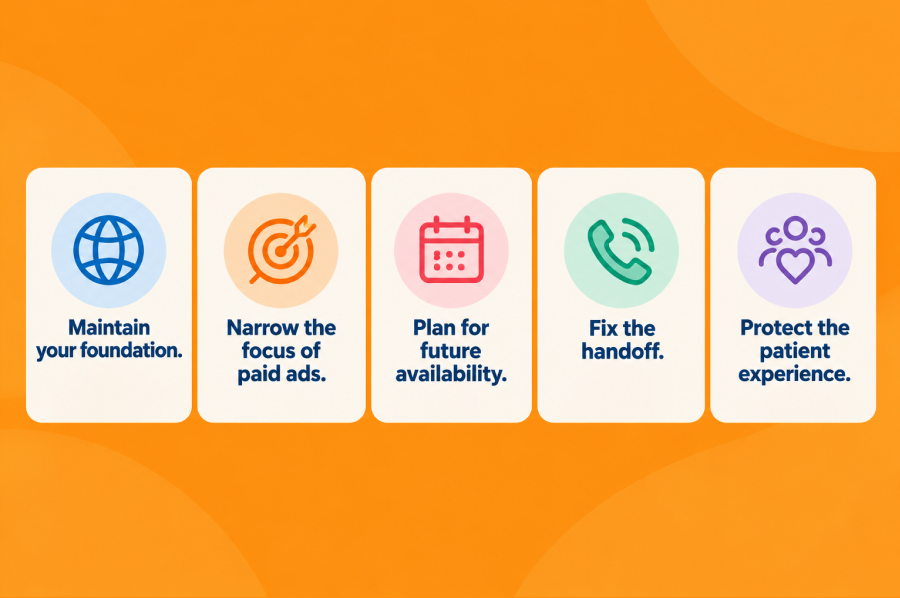
If your team cannot welcome more patients right now, “bring in as many leads as possible” is a poor objective. Start by deciding what type of demand the practice can serve and when. There are several useful options.
Maintain your foundation. Keep your website, Google Business Profile, hours, provider information and key service pages accurate. Continue an appropriate process for requesting patient reviews. These activities help people evaluate the practice and support visibility beyond a single campaign.
Narrow the focus of paid ads. You might reduce broad new-patient campaigns and direct a smaller budget to a treatment or location with genuine capacity. Use a custom landing page for that service, and track calls and appointment requests so you can judge whether the campaign attracts relevant inquiries.
Plan for future availability. If an associate starts in January or the practice is opening new appointment times, prepare the website, service content and campaign assets in advance. Confirm that the team knows how to respond when inquiries arrive.
Fix the handoff. A practice may not need more clicks; it may need better call coverage, a clearer booking process or a response plan for online forms. The ADA’s marketing-plan guidance advises practices to ensure they can handle anticipated increases in new patients and to fine-tune campaigns that attract low-quality inquiries.
Protect the patient experience. Do not promote an urgent service if the practice cannot reasonably respond to those calls. Do not advertise appointment availability that the scheduling team cannot offer. Trust built through marketing can be lost quickly when the experience after the click does not match the message.
Adjustments like these allow a full practice to remain visible without treating every open chair as a marketing emergency.
Q4 Is the Time to Decide What 2027 Should Look Like

The final months of 2026 can make a schedule feel unusually strong. Patients may be trying to complete treatment, use remaining benefits, or plan around holidays, although the timing and reasons differ by practice. At the same time, staff schedules and appointment capacity can shift. A busy October or November should not become the sole forecast for next spring.
Use Q4 to look ahead. Does the practice expect an associate, new hours, a move or a change in services? Which types of cases would you like to see more often in 2027? Do you have openings for new patients in the months when inquiries are likely to arrive? If the answers are unclear, bring the marketing and scheduling teams into the same conversation.
A useful Q4 plan has three parts:
- Measure what is happening now: new-patient inquiries, booked and kept visits, production, desired case mix, lead sources, missed calls and appointment availability.
- Choose what to maintain or adjust: keep foundational visibility accurate, then change paid activity based on actual capacity and goals.
- Prepare for the next quarter: update priority pages, confirm tracking, plan campaigns and make sure the team can respond to the demand you intend to create.
You do not have to predict every cancellation or insurance change. You do need enough visibility to avoid making a long-term decision based only on the next four weeks of appointments.
Frequently Asked Questions About Marketing a Full Dental Practice

Should I Stop Dental Marketing if My Schedule Is Full?
Do not make that decision from the calendar alone. Review new-patient flow, future capacity, production, case mix and the quality of inquiries. You may need to reduce or redirect short-term campaigns, while maintaining the website, local visibility and reputation work that support future demand.
What Is the Difference Between a Full Schedule and a Healthy Patient Pipeline?
A full schedule shows booked appointments for a specific period. A healthy pipeline shows that prospective patients continue to discover and contact your practice, and that your team can convert that interest into kept appointments over time. Both matter, but they answer different questions.
Which Dental Marketing Activities Can I Adjust Quickly?
Paid campaigns can often be changed faster than organic search efforts. You can narrow targeting, update a landing page, adjust budgets or shift promotion to a service with capacity. Check campaign settings and lead quality before making changes, and keep the scheduling team informed.
Why Keep Working on SEO if I Cannot Take More Patients Today?
Search improvements do not always produce an immediate result. Maintaining accurate service pages, local information, and a usable website helps future patients find and evaluate your practice. If capacity is limited, use this period to strengthen content for the services and times you plan to support later.
What Should I Measure Before Changing My Dental Marketing Strategy?
Start with new-patient inquiries, booked and kept appointments, production, treatment mix, wait times, missed calls and lead sources. Compare several months and ask the team what happens after an inquiry arrives. Traffic and leads are useful, but they do not show the whole patient journey.
How Should a Dental Practice Plan Marketing for 2027?
Work backward from capacity and practice goals. Decide which services and patient needs you can support, maintain foundational visibility, prepare priority pages and campaigns, and confirm how calls and forms will be handled. Revisit the plan as staffing, schedules and patient demand change.
A Full Calendar is a Starting Point, Not a Growth Strategy

Being busy is a good reason to ask better questions. Are the appointments on the books helping your practice move toward its goals? Are new patients still entering? Will the team have capacity when future demand arrives? Which parts of your marketing are creating value now, and which should change?
At Gargle, we believe dental marketing should respond to those answers. Sometimes that means promoting a specific service. Sometimes it means improving the website, protecting local visibility, or fixing how inquiries become appointments. It does not mean filling the practice with leads it cannot serve.
Do not mistake a full schedule for a finished growth strategy. Use the leverage of a busy quarter to decide what you want the next one to become. Contact us today!