

When a dental practice has openings in the schedule, the natural reaction is often to assume there is a marketing problem. We need more leads. We need more website traffic. We need more new patients.
Sometimes that’s true. But before investing more money into generating demand, there is another question worth asking: What is happening to the opportunities you already have?
Improving dental marketing ROI isn’t always about attracting more people. A practice may already have prospective patients visiting its website, calling the office, scheduling appointments, receiving treatment plans, and entering the patient database. The problem is that some of those opportunities disappear before they ever become production.
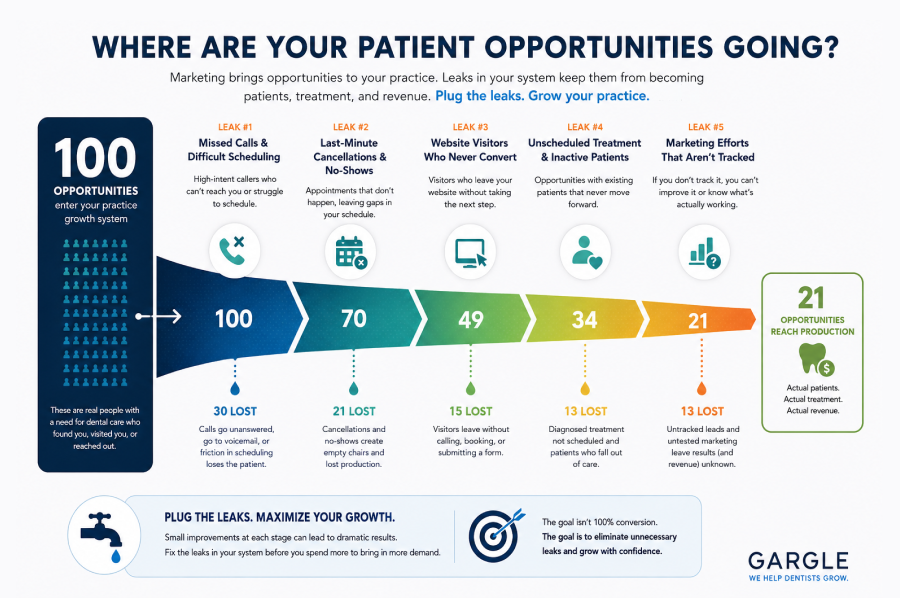
At Gargle, we think about growth as an entire system. Marketing generates demand, but sustainable growth depends on what happens to that demand after it arrives. A missed phone call, an abandoned website visit, a no-show, an unscheduled treatment plan, or an untracked lead can all create small leaks that add up to significant lost opportunity.
Before turning up the faucet, it may be time to find the leaks.
Dental Marketing ROI Is About More Than Generating Leads

Marketing metrics can make a campaign look successful long before it actually produces revenue. Impressions are not patients. Website visitors are not appointments. Phone calls are not completed treatment.
Ultimately, a prospective patient has to move through several stages:
Search → Website Visit → Lead → Appointment → Patient → Treatment → Revenue
Every transition represents an opportunity for growth, but it also represents an opportunity for someone to disappear.
Imagine that your marketing generates 100 legitimate patient opportunities in a month. If prospective patients encounter friction when scheduling, fail to show for appointments, leave the website without contacting you, or never move forward with the treatment they were diagnosed with, only a portion of those original opportunities may ultimately generate revenue.
Increasing the number at the top of the funnel can help, but it does not fix what is happening further down.
In fact, sending more leads into a system with significant leaks can simply make your marketing more expensive.
That’s why evaluating dental marketing ROI requires looking beyond how many leads were generated and examining how effectively the practice converts existing demand into actual patient relationships and treatment.
Leak #1: Missed Calls and Difficult Scheduling

Consider everything that happens before a prospective patient calls a dental office. They recognize a need, search for a solution, compare practices, read reviews, visit a website, and finally decide which practice they want to contact.
By the time the phone rings, much of the difficult marketing work has already happened.
Then nobody answers.
Maybe the team is helping patients at the front desk. Maybe the call comes in during lunch. Perhaps it happens after hours, goes to voicemail, or the caller is placed on hold for too long. Even when the call is answered, complicated scheduling or a slow follow-up process can create another opportunity for the patient to leave.
And today’s prospective patient probably isn’t waiting around. The next dental practice is already sitting in their search results.
This is why call tracking should reveal more than total call volume. Practices should understand how many calls are answered, when missed calls occur, which marketing sources generate them, and whether those calls ultimately become appointments.
Online scheduling and other convenient conversion options can also help capture patients who prefer not to call or who are searching outside normal office hours.
The most expensive lead may be the one you already paid for and never answered.
If marketing is successfully generating high-intent calls but those calls aren’t converting into scheduled patients, simply spending more to generate additional calls doesn’t address the real problem.
Leak #2: Last-Minute Cancellations and No-Shows

A full schedule today does not guarantee a full schedule tomorrow.
Last-minute cancellations and no-shows can turn what looked like a productive week into a collection of unexpected openings. The financial impact goes beyond the empty appointment itself because the practice has already committed resources to that time.
This is also where practices should think differently about acquisition metrics.
Suppose one marketing campaign generates 50 scheduled new-patient appointments while another generates 35. Looking only at scheduled appointments, the first campaign appears to be the obvious winner.
But what happens if only 25 of those 50 patients actually show, while 31 of the 35 patients from the second campaign arrive for their appointments?
The quality of the opportunity matters.
Reducing this leak requires coordination between marketing, scheduling, and patient communication. Appointment reminders, confirmation workflows, simple rescheduling options, and processes for filling short-notice openings can all help protect schedule integrity.
Practices should also examine patterns. Are no-shows particularly common among leads from a specific source? Are certain appointment types canceled more frequently? Is there a long delay between the initial inquiry and the first available appointment?
Those insights can tell a much more useful story than a report that simply celebrates the number of appointments generated.
Leak #3: Website Visitors Who Never Convert

Dental practices put considerable effort into getting people to their websites. SEO earns visibility in search results. Paid advertising generates clicks. Social media builds awareness. Reviews and local listings help prospective patients discover the practice.
But getting someone to the website is only half the job.
A website with strong traffic but poor conversion is a major growth leak.
The reasons can be surprisingly simple. A phone number may be difficult to find on mobile. Calls to action may be vague or buried. Pages may load slowly. Online scheduling may be unavailable or confusing. Service pages may provide generic information without explaining why the patient should choose that particular practice.
Trust is another major factor.
A patient considering dental implants, cosmetic dentistry, clear aligners, or another significant treatment is unlikely to make a decision based on a “Contact Us” button alone. They want to know who will be treating them, what experience the practice has, what the process involves, what other patients have experienced, and whether treatment is financially realistic.
A strong dental website should answer those questions while making the next step obvious.
This is where conversion rate becomes just as important as traffic.
If a practice has 1,000 qualified website visitors every month, there are two ways to generate more opportunities. The practice can spend more money trying to attract another 1,000 visitors, or it can determine why more of the existing 1,000 aren’t converting.
Often, the best strategy involves both. But the second opportunity is easy to overlook.
At Gargle, we don’t believe a website should simply prove that a dental practice exists. It should actively help turn patient interest into action.
Leak #4: Unscheduled Treatment and Inactive Patients

Some of the most valuable growth opportunities may not be prospective patients at all.
They may already be in your practice management system.
Think about the patient who was diagnosed with a crown but never scheduled. The implant consultation ended with, “I need to think about it.” The patient hasn’t returned for hygiene in 18 months. The Invisalign prospect who was interested but wasn’t ready to move forward at the time.
Practices frequently invest significant resources in acquiring new patients while overlooking people who already know the practice, have interacted with the team, and may already have a diagnosed need.
That’s an important distinction.
Acquiring a completely new patient requires building awareness and trust from the beginning. Re-engaging an existing or previous patient starts much further along in the relationship.
Patient reactivation, treatment follow-up, educational communication, and targeted outreach can help practices recover some of these opportunities. The goal isn’t to bombard patients with generic messages. It is to provide relevant reasons to re-engage based on where they are in their patient journey.
A patient with unscheduled treatment may need more information about the procedure. Someone who delayed treatment because of cost may benefit from learning about financing. An overdue hygiene patient may simply need a convenient reminder and an easy way to schedule.
Growth doesn’t always require finding someone new.
Sometimes it means doing a better job of staying connected with the people who have already chosen you.
Leak #5: Marketing Efforts That Aren’t Tracked

The fifth leak is different because you can’t always see it.
A practice may be generating new patients and production through marketing without clearly understanding where those results are coming from. When that happens, the practice cannot confidently determine what to continue, what to change, or where to invest next.
Marketing reports can compound the problem.
A practice owner receives a report showing thousands of impressions, hundreds of clicks, increasing website traffic, a healthy click-through rate, and improving keyword positions.
All useful information.
But eventually, the owner has a much simpler question:
Did this actually grow my practice?
That’s where tracking has to connect marketing activity to meaningful outcomes.
Where did the lead originate? Did the patient call, submit a form, or schedule online? Was the call answered? Did the lead schedule? Did the patient show? What treatment were they interested in?
The closer a practice can get to connecting marketing sources with real patient outcomes, the better it can understand its dental marketing ROI.
Without that visibility, practices risk cutting campaigns that are producing valuable patients or continuing to invest in channels that generate activity without meaningful results.
Data shouldn’t exist just to create a marketing report. It should help practices make better business decisions.
Give Your Practice a Growth Leak Test
You don’t need a complicated analysis to begin identifying potential leaks. Start with a few questions about what happened in your practice last month.
How many incoming calls went unanswered? What percentage of marketing leads became scheduled appointments? How many scheduled new patients actually showed? What percentage of website visitors took a meaningful conversion action? How much diagnosed treatment remains unscheduled? How many patients are overdue for continuing care? Can you identify which marketing sources generated your new patients?
Most importantly, can you connect your marketing activity to meaningful practice outcomes?
If several of those questions are difficult to answer, that tells you something valuable.
You may have found another leak: visibility into your own growth.
Finding that information doesn’t mean every lost opportunity can or should be recovered. No practice converts 100% of website visitors, every caller, every treatment plan, or every patient. That isn’t a realistic goal.
The objective is to identify where unnecessary friction is costing the practice opportunities and determine which improvements could have the greatest impact.
More Marketing Isn’t Always the First Answer

There will always be times when a dental practice genuinely needs more demand. A new office may need greater local awareness. A practice adding implants may need to reach patients searching for that treatment. A growing office may need SEO, paid advertising, content, reputation management, and other strategies to expand its patient base.
But generating more demand should not happen in isolation.
At Gargle, we look at dental marketing as a connected growth system. Visibility matters. Traffic matters. Leads matter. But so do conversion, patient experience, retention, tracking, and the ability to understand what is happening between a patient’s first search and completed treatment.
That broader view can reveal opportunities that are easy to miss when marketing is measured only by how many leads enter the top of the funnel.
If your practice has open appointments, the answer may be more marketing.
Or the opportunity may already be there.
Before asking, “How do we get more patients?” ask another question first:
“What is happening to the opportunities we already have?”
Finding the answer could be one of the most effective ways to improve your dental marketing ROI. Book a demo today!